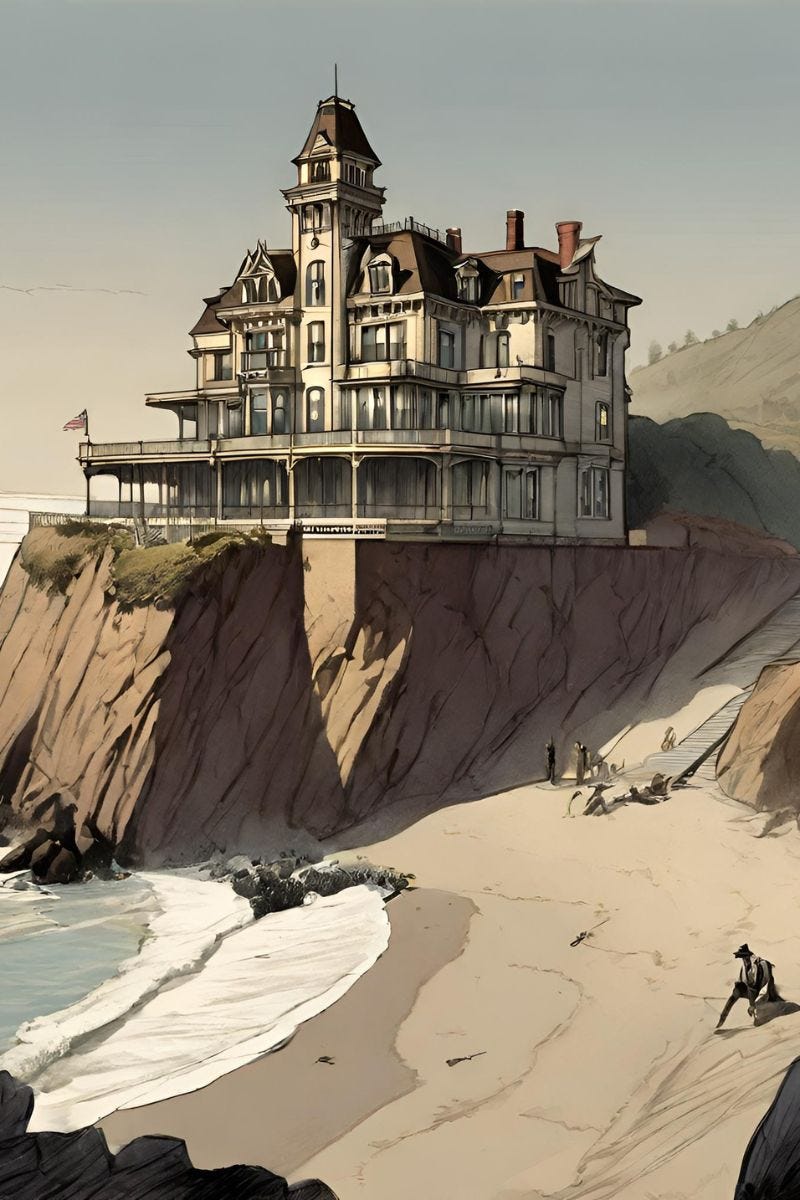
In this segment titled ‘Our Lost History,’ I will write about forgotten or lesser-known aspects of our past.
I am most fascinated with 19th-century architecture, whether grand buildings or quaint homes.
A mysterious and elegant aura surrounding these structures ignites a sense of wonder within me. It’s intriguing to observe how architecture intertwines with psychology.
This brings me to the topic at hand which is an iconic structure that once graced the coast of San Francisco, California, between 1896 and 1907.
It stood as a symbol of the city’s coastal beauty during the late 19th and early 20th centuries, with an interesting and unusual history.
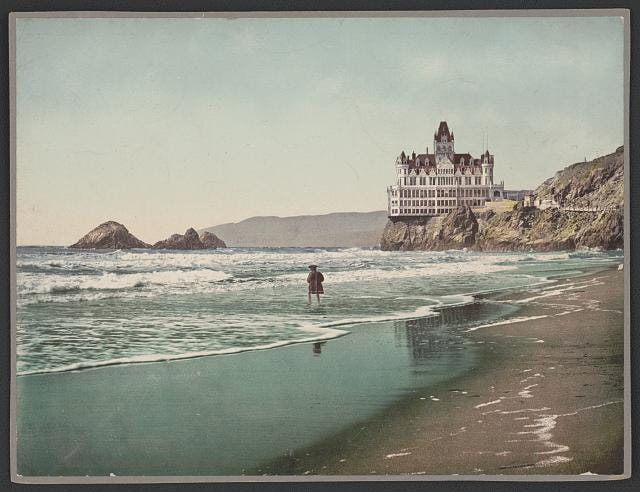
The first Cliff House was built on a rocky cliff in 1863, serving as a fashionable resort for the wealthy and elite.
When I first saw this building in a book called “The Birth of a Century: Early Colored Photographs of America by Jim Hughes“ (that I found in a local antique store) I was amazed by its beauty and mystery.
Perched atop the cliff, this one-story wood-frame structure offered breathtaking views of the Pacific coastline from every angle.
Two catastrophic events led to the destruction of the first Cliff House.
The first event was on January 16th, 1887, when a schooner, a type of sailing vessel, named Parallel ran aground, a situation in which a vessel, such as a ship or boat, becomes stuck or stranded on the bottom of a body of water, and was abandoned but left with burning oil lamps onboard the ship.
Also, it was carrying cargo that included dynamite powder. The burning lamps ignited the dynamite, which exploded so powerfully that it was heard a hundred miles away.
This massive explosion damaged the Cliff House, specifically destroying the entire north wing of the small tavern.
The second event that would destroy the building took place on Christmas night in 1894.
The Cliff house was destroyed by fire due to a defective flue, likely a problem with the chimney or venting system of the building, despite the repairs after the explosion in 1887 the fire ultimately destroyed the building.
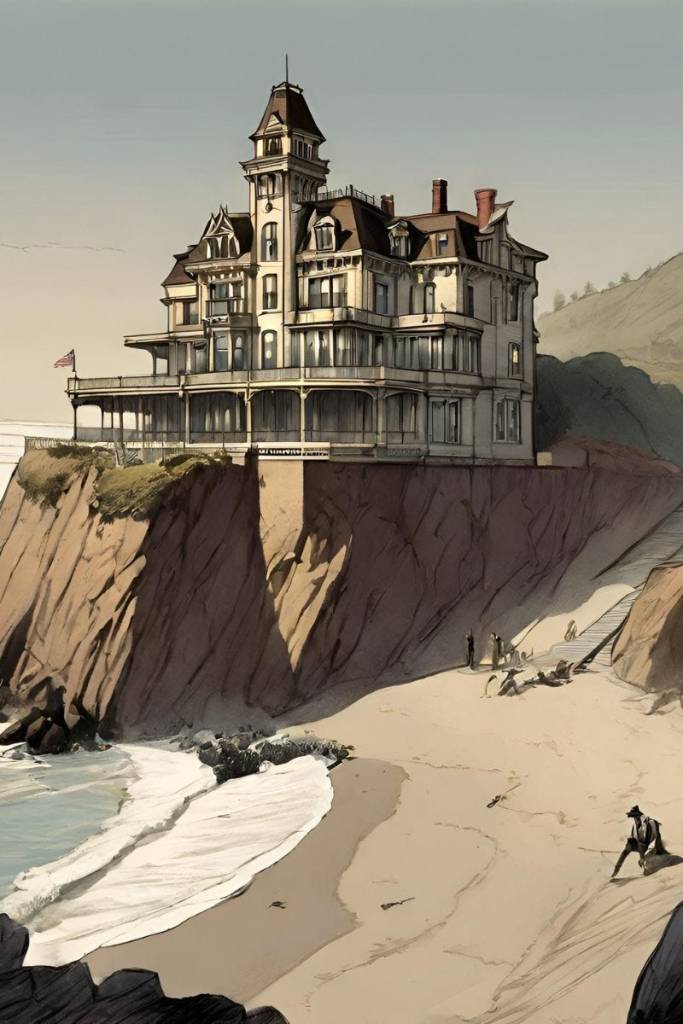
In 1896, Adolph Sutro acquired the property, leading to the construction of the second Cliff House — a magnificent Victorian chateau with seven stories, often referred to as the ‘Gingerbread Palace.’
This resort boasted modern amenities, such as six large indoor swimming pools, a museum, a skating rink, restaurants, ballrooms, observation decks, and other accommodations for guests which attracted renowned figures of that time such as Mark Twain, Jack London, Ulysses S. Grant and others.
Despite initial success, economic downturns and natural disasters, such as the 1906 earthquake, led to the decline of the second Cliff House.
Then in 1907, the Cliff House was closed for renovations.
On September 7th, 1907, James Wilkins, a former proprietor, was wandering around the building to look at the remodeling when he saw smoke.
The smoke came from where electricians had been working.
The alarm was ranged and Wilkins had to be rescued among the flames, and just like that the Second Cliff House was destroyed by fire.
The San Francisco Examiner described the fire as “something sent from the unknown to hold the human mind in awe and wonderment.”
The third and final Cliff House, built in 1909 and still standing today, adopts a simpler neo-classical style.
While lacking the glamour of its predecessor, it still is on that beautiful cliff looking over the beautiful California Sea.
The Cliff House sign has been removed, and the building has been closed due to COVID-19, they are searching for a vendor to take over.
My favorite Cliff house is the Second Cliff house. It looks like a mysterious castle sitting on an ocean cliff.
It is a remarkable story of a magnificent building that tried to survive, but in the end, it couldn’t.
At times I ponder on why we don’t want to build beautiful, interesting structures anymore for the average citizens to look at.
Buildings, and structures for some reason connect to our souls, and can either make us feel wonder or uncertainty about our existence in modern society.
If you google famous and wealthy people’s homes a lot of them are beautiful masterpieces with old classical styles and they are tucked away and hidden from site.
We average citizens can not witness the beauty of structures, instead, we have our mundane copy-paste buildings that don’t spark any wonder but are only built quickly for a purpose and that is all.
Overall, I am trying to highlight the shift in architectural values from the wonder and aesthetic appeal of historical buildings to the functionality and efficiency of modern construction.
What does it mean, and how does architecture affect our emotions and psychology?
Please comment on what you think. Have our modern buildings lost their soul?
Social Links:
Website: Whenstarsmisguideus.com
Email: Whenstarsmisguideus@yahoo.com
Stars Misguide Music: Spotify | Youtube
Instagram: @WhenStarsMisguideUs


 When Stars Misguide Us
Leave a reply to 1dancequeendq Cancel reply